

CPU调度器如何工作?#
NumPy 调度器基于多源编译,这意味着将一个特定的源文件通过不同的编译器标志和影响代码路径的不同 **C** 定义进行多次编译。这使得每个编译后的对象能够根据所需的优化支持特定的指令集,最后将返回的对象链接在一起。
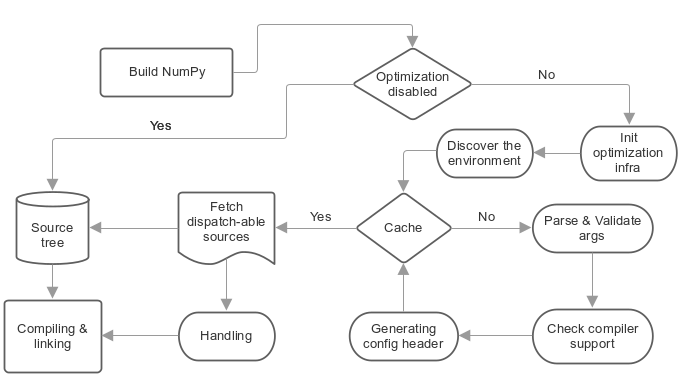
这种机制应该支持所有编译器,并且不需要任何特定于编译器的扩展,但同时它也增加了几个比正常编译步骤更多的步骤,如下所述。
1- 配置#
在通过上面解释的两个命令行参数开始构建源文件之前,由用户配置所需的优化。
--cpu-baseline: 所需优化的最小集合。--cpu-dispatch: 分派的附加优化集合。
2- 环境发现#
在此部分,我们检查编译器和平台架构,并缓存一些中间结果以加速重建。
3- 验证请求的优化#
通过与编译器进行测试,并根据请求的优化查看编译器支持哪些。
4- 生成主配置文件头#
生成的头文件 _cpu_dispatch.h 包含在先前步骤中已验证的所需优化指令集的所有定义和头文件。
它还包含用于定义 NumPy 的 Python 级别模块属性 __cpu_baseline__ 和 __cpu_dispatch__ 的额外 C 定义。
此头文件中包含什么?
示例头文件是 gcc 在 X86 机器上动态生成的。编译器支持 --cpu-baseline="sse sse2 sse3" 和 --cpu-dispatch="ssse3 sse41",结果如下。
// The header should be located at numpy/numpy/_core/src/common/_cpu_dispatch.h
/**NOTE
 ** C definitions prefixed with "NPY_HAVE_" represent
 ** the required optimizations.
 **
 ** C definitions prefixed with 'NPY__CPU_TARGET_' are protected and
 ** shouldn't be used by any NumPy C sources.
 */
/******* baseline features *******/
/** SSE **/
#define NPY_HAVE_SSE 1
#include <xmmintrin.h>
/** SSE2 **/
#define NPY_HAVE_SSE2 1
#include <emmintrin.h>
/** SSE3 **/
#define NPY_HAVE_SSE3 1
#include <pmmintrin.h>

/******* dispatch-able features *******/
#ifdef NPY__CPU_TARGET_SSSE3
  /** SSSE3 **/
  #define NPY_HAVE_SSSE3 1
  #include <tmmintrin.h>
#endif
#ifdef NPY__CPU_TARGET_SSE41
  /** SSE41 **/
  #define NPY_HAVE_SSE41 1
  #include <smmintrin.h>
#endif
基线特性 是通过 --cpu-baseline 配置的所需优化的最小集合。它们没有预处理器保护,并且始终开启,这意味着它们可以在任何源文件中使用。
这是否意味着 NumPy 的基础架构会将基线特性的编译器标志传递给所有源文件?
绝对是的。但是 可分派源 的处理方式不同。
如果用户在构建时指定了某些 **基线特性**,但在运行时机器甚至不支持这些特性,会怎样?编译后的代码会通过这些定义之一调用,还是编译器本身会根据提供的命令行编译器标志自动生成/矢量化某些代码片段?
在加载 NumPy 模块期间,有一个验证步骤会检测到这种行为。它会引发 Python 运行时错误,告知用户。这是为了防止 CPU 遇到非法指令错误导致段错误。
可分派特性 是我们通过 --cpu-dispatch 配置的分派的附加优化集合。它们默认不激活,并且始终由带有 NPY__CPU_TARGET_ 前缀的其他 C 定义进行保护。C 定义 NPY__CPU_TARGET_ 仅在 **可分派源** 内启用。
5- 可分派源和配置语句#
可分派源是特殊的 **C** 文件,可以通过不同的编译器标志和不同的 **C** 定义进行多次编译。这些会影响代码路径,根据必须在 **C** 注释(/**/) 之间声明并在每个可分派源顶部以特殊标记 **@targets** 开头的“**配置语句**”来支持特定指令集。同时,如果通过命令行参数 --disable-optimization 禁用了优化,可分派源将作为普通 **C** 源文件处理。
什么是配置语句?
配置语句是一种关键字组合,用于确定可分派源所需的优化。
示例
/*@targets avx2 avx512f vsx2 vsx3 asimd asimdhp */
// C code
这些关键字主要代表通过 --cpu-dispatch 配置的附加优化,但它也可以代表其他选项,例如
目标组:预先配置的配置语句,用于从可分派源外部管理所需的优化。
策略:用于更改默认行为或强制编译器执行某些操作的选项集合。
“baseline”:一个独特的关键字,代表通过
--cpu-baseline配置的最小优化。
Numpy 的基础架构处理可分派源有四个步骤。:
(A) 识别:就像源模板和 F2PY 一样,可分派源需要一个特殊的扩展名
*.dispatch.c来标记 C 可分派源文件,对于 C++,则是*.dispatch.cpp或*.dispatch.cxx**注意**:C++ 尚不支持。(B) 解析和验证:在此步骤中,经过上一步过滤的可分派源会逐个被配置语句解析和验证,以确定所需的优化。
(C) 包装:这是 NumPy 基础架构采用的方法,已被证明足够灵活,可以多次使用不同的 **C** 定义和影响代码路径的标志来编译单个源文件。该过程通过为每个所需的附加优化创建一个临时的 **C** 源文件来实现,该文件包含 **C** 定义的声明并通过 **C** 指令 **#include** 包含相关的源文件。为了更清晰,请看以下 AVX512F 的代码。
/*
 * this definition is used by NumPy utilities as suffixes for the
 * exported symbols
 */
#define NPY__CPU_TARGET_CURRENT AVX512F
/*
 * The following definitions enable
 * definitions of the dispatch-able features that are defined within the main
 * configuration header. These are definitions for the implied features.
 */
#define NPY__CPU_TARGET_SSE
#define NPY__CPU_TARGET_SSE2
#define NPY__CPU_TARGET_SSE3
#define NPY__CPU_TARGET_SSSE3
#define NPY__CPU_TARGET_SSE41
#define NPY__CPU_TARGET_POPCNT
#define NPY__CPU_TARGET_SSE42
#define NPY__CPU_TARGET_AVX
#define NPY__CPU_TARGET_F16C
#define NPY__CPU_TARGET_FMA3
#define NPY__CPU_TARGET_AVX2
#define NPY__CPU_TARGET_AVX512F
// our dispatch-able source
#include "/the/absolute/path/of/hello.dispatch.c"
(D) 可分派配置文件头:基础架构为每个可分派源生成一个配置文件头,该头文件主要包含两个抽象 **C** 宏,用于标识生成的对象,以便任何 **C** 源文件可以在运行时分派这些生成的对象中的特定符号。它也用于前向声明。
生成的头文件名采用可分派源文件名,去除扩展名并将 .h 替换,例如,假设我们有一个名为
hello.dispatch.c的可分派源,其内容如下。// hello.dispatch.c /*@targets baseline sse42 avx512f */ #include <stdio.h> #include "numpy/utils.h" // NPY_CAT, NPY_TOSTR #ifndef NPY__CPU_TARGET_CURRENT // wrapping the dispatch-able source only happens to the additional optimizations // but if the keyword 'baseline' provided within the configuration statements, // the infrastructure will add extra compiling for the dispatch-able source by // passing it as-is to the compiler without any changes. #define CURRENT_TARGET(X) X #define NPY__CPU_TARGET_CURRENT baseline // for printing only #else // since we reach to this point, that's mean we're dealing with // the additional optimizations, so it could be SSE42 or AVX512F #define CURRENT_TARGET(X) NPY_CAT(NPY_CAT(X, _), NPY__CPU_TARGET_CURRENT) #endif // Macro 'CURRENT_TARGET' adding the current target as suffix to the exported symbols, // to avoid linking duplications, NumPy already has a macro called // 'NPY_CPU_DISPATCH_CURFX' similar to it, located at // numpy/numpy/_core/src/common/npy_cpu_dispatch.h // NOTE: we tend to not adding suffixes to the baseline exported symbols void CURRENT_TARGET(simd_whoami)(const char *extra_info) { printf("I'm " NPY_TOSTR(NPY__CPU_TARGET_CURRENT) ", %s\n", extra_info); }
现在假设您已将 **hello.dispatch.c** 添加到源树中,那么基础架构应该会生成一个名为 **hello.dispatch.h** 的临时配置文件头,该头文件可以在源树中的任何源文件中访问,并且应包含以下代码。
#ifndef NPY__CPU_DISPATCH_EXPAND_
  // To expand the macro calls in this header
    #define NPY__CPU_DISPATCH_EXPAND_(X) X
#endif
// Undefining the following macros, due to the possibility of including config headers
// multiple times within the same source and since each config header represents
// different required optimizations according to the specified configuration
// statements in the dispatch-able source that derived from it.
#undef NPY__CPU_DISPATCH_BASELINE_CALL
#undef NPY__CPU_DISPATCH_CALL
// nothing strange here, just a normal preprocessor callback
// enabled only if 'baseline' specified within the configuration statements
#define NPY__CPU_DISPATCH_BASELINE_CALL(CB, ...) \
  NPY__CPU_DISPATCH_EXPAND_(CB(__VA_ARGS__))
// 'NPY__CPU_DISPATCH_CALL' is an abstract macro is used for dispatching
// the required optimizations that specified within the configuration statements.
//
// @param CHK, Expected a macro that can be used to detect CPU features
// in runtime, which takes a CPU feature name without string quotes and
// returns the testing result in a shape of boolean value.
// NumPy already has macro called "NPY_CPU_HAVE", which fits this requirement.
//
// @param CB, a callback macro that expected to be called multiple times depending
// on the required optimizations, the callback should receive the following arguments:
//  1- The pending calls of @param CHK filled up with the required CPU features,
//     that need to be tested first in runtime before executing call belong to
//     the compiled object.
//  2- The required optimization name, same as in 'NPY__CPU_TARGET_CURRENT'
//  3- Extra arguments in the macro itself
//
// By default the callback calls are sorted depending on the highest interest
// unless the policy "$keep_sort" was in place within the configuration statements
// see "Dive into the CPU dispatcher" for more clarification.
#define NPY__CPU_DISPATCH_CALL(CHK, CB, ...) \
  NPY__CPU_DISPATCH_EXPAND_(CB((CHK(AVX512F)), AVX512F, __VA_ARGS__)) \
  NPY__CPU_DISPATCH_EXPAND_(CB((CHK(SSE)&&CHK(SSE2)&&CHK(SSE3)&&CHK(SSSE3)&&CHK(SSE41)), SSE41, __VA_ARGS__))
以上面为例,在配置头文件中的一个例子。
// NOTE: The following macros are only defined for demonstration purposes only.
// NumPy already has a collections of macros located at
// numpy/numpy/_core/src/common/npy_cpu_dispatch.h, that covers all dispatching
// and declarations scenarios.

#include "numpy/npy_cpu_features.h" // NPY_CPU_HAVE
#include "numpy/utils.h" // NPY_CAT, NPY_EXPAND

// An example for setting a macro that calls all the exported symbols at once
// after checking if they're supported by the running machine.
#define DISPATCH_CALL_ALL(FN, ARGS) \
    NPY__CPU_DISPATCH_CALL(NPY_CPU_HAVE, DISPATCH_CALL_ALL_CB, FN, ARGS) \
    NPY__CPU_DISPATCH_BASELINE_CALL(DISPATCH_CALL_BASELINE_ALL_CB, FN, ARGS)
// The preprocessor callbacks.
// The same suffixes as we define it in the dispatch-able source.
#define DISPATCH_CALL_ALL_CB(CHECK, TARGET_NAME, FN, ARGS) \
  if (CHECK) { NPY_CAT(NPY_CAT(FN, _), TARGET_NAME) ARGS; }
#define DISPATCH_CALL_BASELINE_ALL_CB(FN, ARGS) \
  FN NPY_EXPAND(ARGS);

// An example for setting a macro that calls the exported symbols of highest
// interest optimization, after checking if they're supported by the running machine.
#define DISPATCH_CALL_HIGH(FN, ARGS) \
  if (0) {} \
    NPY__CPU_DISPATCH_CALL(NPY_CPU_HAVE, DISPATCH_CALL_HIGH_CB, FN, ARGS) \
    NPY__CPU_DISPATCH_BASELINE_CALL(DISPATCH_CALL_BASELINE_HIGH_CB, FN, ARGS)
// The preprocessor callbacks
// The same suffixes as we define it in the dispatch-able source.
#define DISPATCH_CALL_HIGH_CB(CHECK, TARGET_NAME, FN, ARGS) \
  else if (CHECK) { NPY_CAT(NPY_CAT(FN, _), TARGET_NAME) ARGS; }
#define DISPATCH_CALL_BASELINE_HIGH_CB(FN, ARGS) \
  else { FN NPY_EXPAND(ARGS); }

// NumPy has a macro called 'NPY_CPU_DISPATCH_DECLARE' can be used
// for forward declarations any kind of prototypes based on
// 'NPY__CPU_DISPATCH_CALL' and 'NPY__CPU_DISPATCH_BASELINE_CALL'.
// However in this example, we just handle it manually.
void simd_whoami(const char *extra_info);
void simd_whoami_AVX512F(const char *extra_info);
void simd_whoami_SSE41(const char *extra_info);

void trigger_me(void)
{
    // bring the auto-generated config header
    // which contains config macros 'NPY__CPU_DISPATCH_CALL' and
    // 'NPY__CPU_DISPATCH_BASELINE_CALL'.
    // it is highly recommended to include the config header before executing
  // the dispatching macros in case if there's another header in the scope.
    #include "hello.dispatch.h"
    DISPATCH_CALL_ALL(simd_whoami, ("all"))
    DISPATCH_CALL_HIGH(simd_whoami, ("the highest interest"))
    // An example of including multiple config headers in the same source
    // #include "hello2.dispatch.h"
    // DISPATCH_CALL_HIGH(another_function, ("the highest interest"))
}